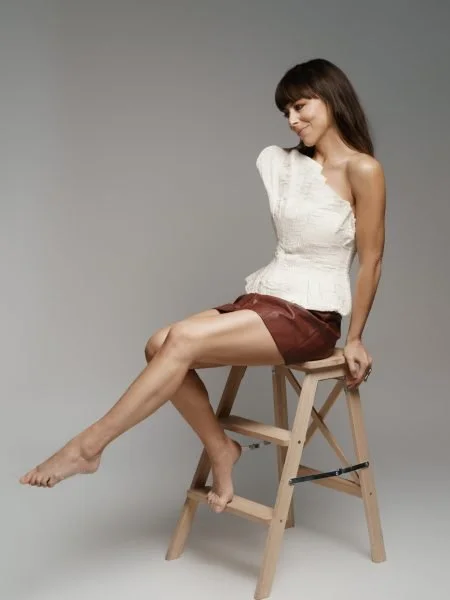
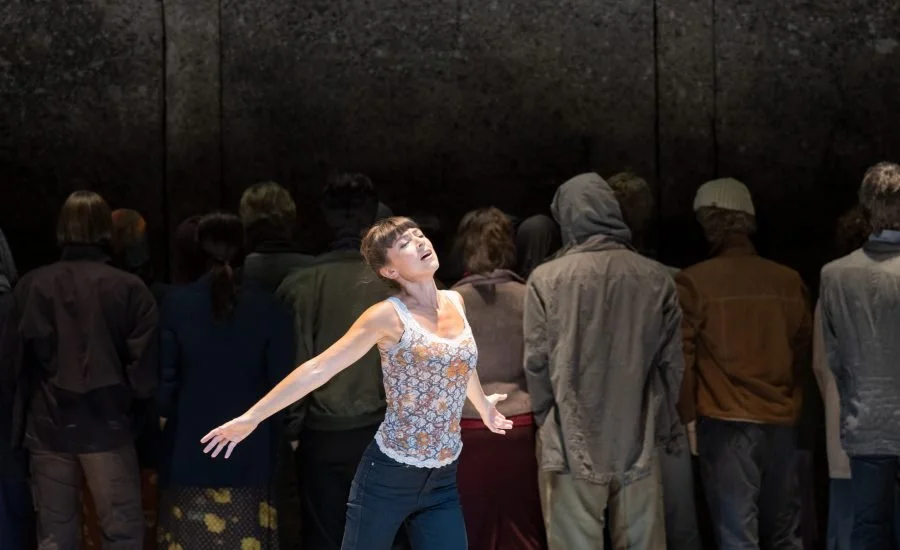
Feature: Marie Claire Germany

She sings in six languages, has thrilled audiences in over 30 leading roles at the most prestigious stages, and enjoys worldwide success. In this interview, Corinne Winters offers fascinating insights into the world of opera.

Opera Singer Corinne Winters: Between Stage and Balance

Corinne Winters is one of the most exciting voices in the modern opera scene. Hailed by the New York Times as "an extraordinary actress and singer of remarkable grace and finesse," she has already performed over 30 leading roles at the world's most prestigious opera houses. In 2022, she achieved international acclaim with her portrayal of Káťa Kabanová at the Salzburg Festival. The American soprano returned to her signature role for a new production in Munich in February 2025.

At Home on the World's Great Stages

When we meet at the beginning of 2025, Winters still has a lot on her plate. Later that year, she would sing her first leading role at the Metropolitan Opera. "As Mimi in La Bohème," she tells us. "That's special for me because it was one of the first roles I ever sang." She has also sung in Prague, Washington, Athens, and Houston. Until December 10th, she can be seen in performances of "Madame Butterfly" at the Staatsoper Unter den Linden in Berlin. In an interview with Marie Claire, she talks about life as an opera singer, the challenges it brings, and the importance of authenticity and balance. She also reveals her upcoming plans on the world's great stages.

The Daily Life of an Opera Singer

Marie Claire: Her concerts fill the world's most prestigious opera houses and concert halls. What is the daily life of an opera singer like?

Corinne Winters: There are two sides to it: life as a performer and the rehearsal process. That means we have rehearsals, which are basically like a normal job. You go to a morning session, then there's a lunch break, and then an evening session. As the premiere approaches, we rehearse on stage, and these rehearsals are usually in the evening. It's really a process—similar to any other profession. But of course, for us, it's all about performing. Then there are the performances, which are sometimes glamorous and exciting, but sometimes they're just part of everyday life. Sometimes it's simply part of the job, and sometimes they're very special moments. So that's the professional side. And then there's life outside of work, which really depends on the individual. It depends on whether the singer has a family, whether she pursues hobbies on the side. We try to fill our time with the things we love – be it through people, activities, or even by taking care of the practical tasks that come with being a singer: traveling, booking accommodation, and managing the business aspects. There's always something going on in the life of an opera singer.

Corinne Winters on her work-life balance: “I’ve learned to be kind to myself.”

Marie Claire: You’ve also been very busy lately: You’ve been in Athens, Washington, and London in recent months. Now you’re in Munich. You constantly have to find your way around new cities. How do you manage to find a balance for yourself?

Corinne Winters: It's not easy. That's something I've had to learn over the years. I've been doing this professionally for 15 years now, and I've realized that balance doesn't always look the same. Sometimes balance means really taking time for self-care and health. But sometimes work simply demands everything. And then balance is more work-specific—and that's okay. Because I've realized that we as artists don't lead normal lives. So we can't expect balance to look the same for us as it does for others. I've learned to be kind to myself. Sometimes I have a great work-life balance with enough time to recover and do other things. And sometimes I'm just too busy. I think acceptance is best. If we're constantly trying to find that perfect balance, it creates more stress than if we simply live life. And as performers, we can't afford too much stress because it directly affects the voice.


Preparing for a New Role

Marie Claire: Do you have specific routines or a particular way of preparing for a new role or production?

Corinne Winters: I really like to be active. I'm a runner and participate in races several times a year. That keeps my body fit and also helps me relieve stress. Sleep is also extremely important. One bad night is okay, maybe even two, but eventually it all adds up and that really affects the voice. That's why I pay close attention to a good sleep routine. And then I consciously set aside time to prepare my music. The more successful and the busier you are, the harder it becomes to prepare properly. But that's what makes a great artist: someone who really takes the time for their craft and doesn't think, "I'm successful, that's enough," and then shows up unprepared. So it's a combination of mental, physical, and musical preparation.

Corinne Winters Sings in 6 Languages

Marie Claire: You sing in several languages: German, Italian, French, Russian, Czech, and Polish. That sounds like a big challenge for the voice. Are there differences when singing in different languages? And if so, how do you deal with them?

Corinne Winters: Some languages ​​are easier to sing than others because they have longer vowels. That makes singing easier because the voice can sound better. I often sing in Czech, and it's similar to German because there are a lot of consonants. But now that I speak the language a little and have immersed myself in it, I've found a way to make it really singable. I used to find German difficult because I don't speak it. But when I started to really engage with the language and its literature, I realized how beautiful it can sound. Any language you immerse yourself in can be beautiful when sung with devotion.

The Role of Kát’a Kabanová

Marie Claire: Now, let's talk about your new role as Kát’a Kabanová. You've already sung it in several productions. Have you discovered new facets of the role in these different productions?

Corinne Winters: I discover new things every time. This character and the piece are so profound. Kát’a is full of facets and contradictions: she's very connected to nature, but also dreamy and lost in her imagination. She's strong, but also incredibly vulnerable. That's what makes her so fascinating, but also challenging. My task is to show these contrasts, but also to bring my own soul to it. It's the combination of my interpretation of the character and my personal essence that's present in every production. Every production and every director emphasizes a new side of the character. In this production (Editor's note: This refers to the Munich production in which she sang in spring 2025), Kát’a is very intense and inwardly restless. She has so many emotions inside her, but she has to suppress them. And when they erupt, it's all the more powerful. I think the feeling of not being able to express oneself freely is still very relevant today.

The Therapeutic Side

Marie Claire: Do you also recognize yourself personally in the contradictions you mentioned?

Corinne Winters: I'm drawn to characters whose central inner conflict I recognize in myself. Not necessarily in their life circumstances, which can be different for everyone, but in the emotions they experience. In Kát’a's case, it's this young woman who sees the world differently than the people around her. While she isn't an artist in the story, she has an almost artistic soul. She views life in a creative and inspired way, almost like a child with a vivid imagination and a lot of passion. I can relate to that very well because I felt the same way as a child. In my youth, I often felt misunderstood. Even today, I surround myself with artists and creative people who think differently. But I still see that little girl inside me, vulnerable and imaginative, but sometimes afraid to show that side to the world. In a way, playing these characters is almost therapeutic because you rediscover parts of yourself that might fade into the background in everyday life. I find that fascinating. I think many artists feel the same way: you discover new aspects of yourself or bring a part of your own personality into the role. That's wonderful.

“Even if I were rich, I would still do it.”

Marie Claire: Did you always want to be an opera singer or an artist? Was that your dream?

Corinne Winters: My first dream was to be a writer. I loved singing and music, but I didn't grow up with classical music. It's not very common in America. In Europe, it's different: even if someone doesn't listen to or play classical music, it's still part of the culture. My father loved music, played and sang as a hobby, and I sang in a choir and tried out different instruments. At some point, out of curiosity, I took a singing lesson, and the teacher told me I had an operatic voice and absolutely had to pursue it. I didn't really know what I wanted. I was about to go to university, but I knew nothing about opera. So I thought I could do a double degree—a major plus opera as a minor—and see where it took me. The more I immersed myself in opera, the more I realized what a unique art form it is. It combines theater, singing, orchestral music, set design, fashion, and dance—it's the art form where all the performing arts converge. So I thought to myself: I'll just keep going. And if I'm lucky enough to be successful, I'll stick with it. If not, I'll do something else. I'm incredibly grateful that I've been successful, because it truly is my dream. Even if I were rich, I would still do it.

Corinne Winters' Plans for 2025

Marie Claire: Do you have any plans for 2025 that you can share with us?

Corinne Winters: Oh yes, I do! I'll be making my debut in a leading role at the Metropolitan Opera in New York – as Mimì in La bohème. This is special for me because it was one of the first roles I ever sang. It's also the first time I've sung a leading role at the Met in my home country. The Met is one of the most prestigious opera houses in the world, and La bohème is a timeless role that I've sung many times, including early in my career. It's also a very traditional production. I usually perform in more modern, avant-garde productions, which I love. But for my family and friends in the US, it's something special to see me in New York in a classic La bohème. I'm grateful every day. When I have a few hours to practice, I often ask myself: What should I work on? I hope I never lose this enthusiasm, because if I do, I know it's time to stop.

“Just be yourself.”

Marie Claire: Marie Claire has made it its mission to give a voice to strong women like yourself. What message would you like to share with our readers?

Corinne Winters: Don't try to be someone else, just be yourself. Get to know yourself and let the world come to you. When we are authentic, things often fall into place. But when we try too hard to conform to a certain image or present ourselves in a particular way, we either encounter obstacles or ultimately don't find true fulfillment. It took me a long time to truly internalize this. But now that I'm as authentic as possible in my career and my personal life, my life has changed. I've found so much more joy and purpose. Every woman should accept herself because we are all special in our own way.

Corinne Winter's Upcoming Performances

Those wishing to experience Corinne Winter up close have the following opportunities:

ˑ Recital, Gstaad New Year Music Festival: December 27, 2025

ˑ As Tatyana in "Eugene Onegin" at the Palau de les Arts Reina Sofía, Spain: January 20, 23, 25, 29, and February 1, 2026

ˑ As Nedda in "Pagliacci" at the Teatro del Maggio Musicale Fiorentino, Florence, Italy: February 22, 25, 28, and March 3, 2026

ˑ On June 13 and 14, 2026, she returns to the Munich Philharmonic for Richard Strauss's "Four Last Songs." One day later she will perform in “Jenufa” (Act 2) by L. Janáček with the Bamberg Philharmonic Orchestra.

Photo Credits

Liliya Namisnyk (Portraits)

Monika Rittershaus (Salzburger Festspiele 2022)


To read this article in its original German publication, please click on the following link.

Apple User